Garuda Wisnu Kencana Statue – Indonesia – Bali
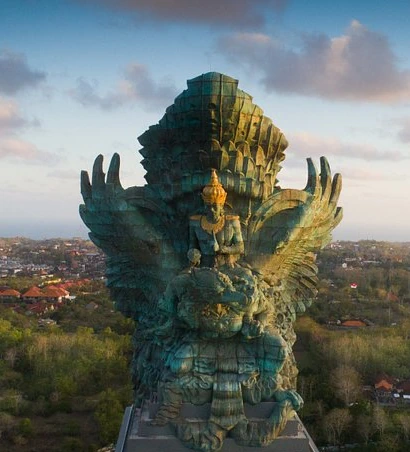
On the southwestern tip of Bali, at the peak of the Bukit Peninsula, a figure dominates the panoramic view formed by tropical forests and the turquoise ocean. This figure is not merely a statue; it is the recreation in a contemporary language of thousands of years of faith, art, and culture flowing from the depths of Hindu mythology. The Garuda Wisnu Kencana Statue, standing at approximately 121 meters tall, ranks among the world's largest statues and has become the most iconic image of the island for the millions of visitors who come to Bali each year. This colossal structure earns a unique place in the history of world art and architecture not only through its size, but also through the profound meanings it carries, its artistic refinement, and the dialogue it establishes with the Balinese landscape.
Nyoman Nuarta: A Master's Lifelong Vision
Behind the Garuda Wisnu Kencana Statue lies decades of labor and passion from Nyoman Nuarta, Indonesia's most important contemporary sculptor. Born in 1945, Nuarta, as an artist of Balinese origin, has a deep knowledge of Balinese culture and Hindu mythology and reflects this wealth of knowledge in his art. Bringing the GWK project to life in the early 1990s, Nuarta set out from the very first design works with the goal that this statue would be not merely a large monument, but a symbol carrying the cultural identity of Bali and Indonesia to the world.
The journey of the project was far from easy. The 1997-98 Asian economic crisis largely wiped out the resources allocated to the project and construction work was suspended for a long period. Financing problems, technical difficulties, and various administrative obstacles blocked the project's path on multiple occasions. However, Nuarta never gave up over the course of decades, seeking at every opportunity to bring the project back to life. The statue, finally completed in 2018, rose on Bali's horizon as the product of approximately 28 years of struggle and labor. This long journey adds not only artistic but also human meaning to the statue.
Garuda and Wisnu in Hindu Mythology
To fully grasp the Garuda Wisnu Kencana Statue, it is necessary to understand two fundamental figures in Hindu mythology. Wisnu is one of the three great gods of the Hindu faith and is the deity who protects the order, balance, and continuity of the universe. Wisnu protects and sustains the universe that Brahma created and Shiva transforms. Descending to earth through different avatars in different ages, Wisnu is recognized as the defender of justice and goodness.
Garuda is a half-human, half-eagle being with deep roots in Hindu and Buddhist mythology. Believed to be Wisnu's mount, Garuda is the symbol of strength, speed, freedom, and protection. Depicted as the enemy of serpents, Garuda represents the struggle of good against evil. Since the official symbol of the Indonesian state is also the Garuda figure, this statue carries both a religious and a national layer of meaning. The depiction of Wisnu atop Garuda creates a multi-layered symbolism that brings together the power of the god and the freedom of Garuda.
Technical Features and the Construction Process
The Garuda Wisnu Kencana Statue is also a remarkably striking structure from an engineering standpoint. With a total height of approximately 121 meters, the statue ranks among the tallest statues in the world when evaluated together with its pedestal. The structure, made from a stainless steel and copper alloy, weighs approximately 4,000 tons. The copper cladding on the surface of the statue was specially designed to be resistant to Bali's tropical climate and salty sea air.
One of the greatest technical challenges encountered during construction was the statue's location at the peak of the Bukit Peninsula. Engineering problems such as wind load calculations, earthquake resistance, and the distribution of the enormous weight across the ground were worked on by expert teams over the course of many years.
GWK Cultural Park: An Experience Beyond the Statue
The Garuda Wisnu Kencana Statue is presented to visitors not as a standalone structure, but as part of a comprehensive complex situated at the center of GWK Cultural Park. This expansive area exceeding 250 hectares encompasses open-air amphitheaters, exhibition spaces, stages for traditional Balinese dance performances, restaurants, and various cultural event venues. Having become one of Bali's most important arts and culture centers, this complex hosts hundreds of cultural events every year.
In particular, the Kecak dance and other traditional Balinese dance performances rank among the most popular events held at GWK Cultural Park. Dance performances at sunset, combined with the golden silhouette of the statue and the crimson hues of the tropical sky, offer one of the most unforgettable cultural experiences that can be had in Bali. This experience takes the statue beyond being merely a means of visual satisfaction and transforms it into part of a multi-sensory and multi-layered cultural whole.
Its Contribution to Bali's Tourism
The GWK Statue occupies an extremely strategic place on Bali's tourism map. The great majority of the more than 6 million foreign tourists who visit the island each year include a GWK visit in their Bali itinerary. Its proximity to popular holiday destinations such as Seminyak, Kuta, and Nusa Dua makes the statue an easily accessible destination. At the same time, GWK, which is also integrated with the cultural routes around Ubud and the island's interior, brings together both the coastal and cultural tourism potential of Bali.
Date Added: