Egyptian Museum - Cairo, Egypt
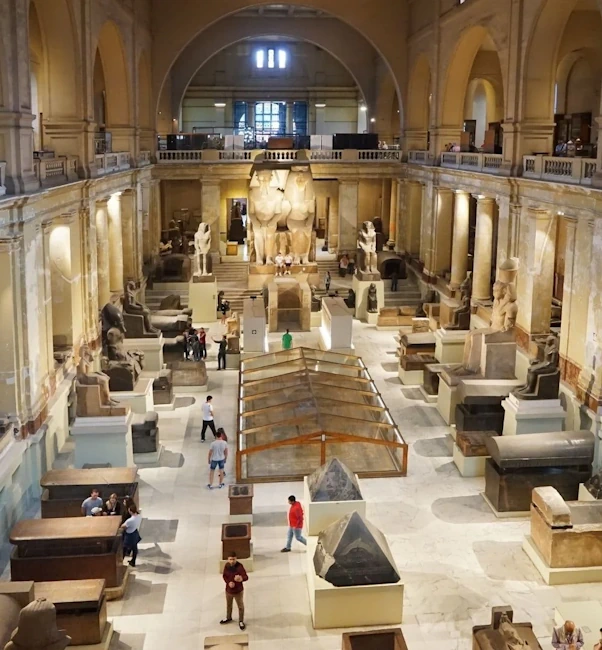
When you visit Cairo, that large pink-toned building greeting you at the northern corner of Tahrir Square is much more than just an ordinary museum. The Egyptian Museum is one of the world's most significant archaeological institutions, housing the most tangible evidence of a five-thousand-year-old civilization under its roof. Here, the traces left by people who lived thousands of years ago turn into a concrete reality; golden masks, colossal statues, and ancient papyri await visitors under the same roof. Visiting Egypt without seeing this museum is like leaving Paris after passing right by the Louvre.
Where is the Egyptian Museum, Information About It
The museum is located in the very heart of Cairo, on the northern side of Tahrir Square. The most practical way to reach the museum, which is easily accessible by public transport, is to get off the metro at Sadat Station; the station opens directly onto Tahrir Square. Thanks to this central location, the museum is within walking distance or a short journey from almost every hotel in Cairo. Its proximity to the Nile bank, major hotels, and other historical sites also makes trip planning very convenient.
Built on an area of 13,600 square meters and featuring over a hundred exhibition halls, the museum is the product of a competition organized by the Egyptian Government in 1895 and holds the distinction of being the first national museum in the Middle East. The architecture of the building is a work of art in itself. Designed by French architect Marcel Dourgnon, the structure reflects a magnificent neo-classical style that blends classical European architecture with Egyptian symbolism. The cornerstone was ceremoniously laid on April 1, 1897, in the presence of the Khedive of the period, Abbas Hilmi II, and the building officially opened in 1902.
A Treasure House Harboring 120,000 Artifacts
The museum hosts the world's largest collection of Egyptian antiquities, gathering over 170,000 artifacts within its walls. These pieces are brought together not just for display, but to understand one of humanity's greatest civilizations. The ground floor primarily houses large-scale objects: massive statues, sarcophagi, reliefs, and stone works. The upper floor displays smaller but equally impressive pieces; papyri, jewelry, daily items, and a portion of the Tutankhamun treasure greet visitors on this level.
Among the museum's unique collections are the complete tomb treasures of Yuya and Thuya, the treasures of Psusennes I and Tanis, and the Narmer Palette, which documents the unification of Upper and Lower Egypt under a single king. Additionally, the magnificent statues of Khufu, Khafre, and Menkaure—the architects of the Giza Pyramids—are among the highlights of the collection. Each representing a piece of history on its own, these artifacts reveal one of the greatest leaps of creativity in human history.
The Tutankhamun Collection: The World's Most Famous Treasure
One of the greatest features that set the Egyptian Museum apart from the rest of the world was the extraordinary collection belonging to Pharaoh Tutankhamun. Thousands of pieces recovered from the young pharaoh's tomb, discovered by Howard Carter in 1922, formed the museum's greatest attraction for many years. The golden mask, the pharaoh's throne, his jewelry, chariots, and all the personal belongings of a ruler preparing for his journey to the afterlife were exhibited in these halls.
With the opening of the Grand Egyptian Museum in Giza, the Tutankhamun collection has been moved to this new museum; however, the Egyptian Museum in Tahrir has not closed its doors. On the contrary, it continues to renew and transform itself. Today, the museum focuses on artifacts that previously did not receive enough attention and special exhibitions exploring different dimensions of the Ancient Egyptian civilization. This change turns the museum from a mere stop for those coming to see Tutankhamun into a center where true Egyptology enthusiasts can conduct in-depth studies.
A Walk Through History: Discovery Layer by Layer
Wandering through the museum is like embarking on an adventure through time. Some exhibition cards have lost their currency as new discoveries have overturned old theories. The collection grew rapidly; for instance, the great treasure of Tutankhamun and the contents of the Tanis tombs were found after the museum opened and had to be squeezed into the existing space. This disorder may seem chaotic to some visitors, but it is exactly why it is possible to encounter a surprising artifact at every corner. This atmosphere, which offers a living, organic, and never-ending environment of discovery rather than a meticulous curatorial approach, is part of the Egyptian Museum's unique charm.
Statues from the Old Kingdom period, in particular, are among the strongest pieces in this museum. The statue of Khafre, the wooden statue of Ka-aper, and the colossal figures of various pharaohs clearly demonstrate the sophisticated level reached by ancient Egyptian sculpture. The jewelry collection is equally striking; pectorals, bracelets, and necklaces made of gold, lapis lazuli, and turquoise reinforce your admiration for the craftsmen of thousands of years ago.
The 2011 Revolution and the Museum's Resilience
The Egyptian Museum has not only hosted historical events but has been a part of history itself. During the most intense days of the 2011 revolution, when the museum came under threat from looters, activists formed a human chain around the building to protect the collection. This effort, which was largely successful, demonstrated the public's devotion to the museum. That night, thousands of years of artifacts managed to reach future generations thanks to the courage of a handful of volunteers. This story reveals the social and emotional value of the museum, transcending its physical boundaries in its simplest form.
Practical Information for Visiting
The museum is open on Fridays from 9:00 AM to 11:00 AM and from 1:30 PM to 7:00 PM; on other days, it is open from 9:00 AM to 7:00 PM. Photography inside the museum is subject to a fee; the use of flash is prohibited as it damages the artifacts. Photography is not allowed in the Golden Mask Room and the Royal Mummy Rooms. To ensure a productive visit, hiring a guide or renting an audio guide is highly recommended, as it can be difficult to track the connections between halls and the stories of the artifacts during an independent visit. Given the size of the collection, a visit duration of 3-4 hours is suggested. Arriving early is the most effective way to avoid the crowds that can form, especially on weekends.
Date Added: