Crazy Horse Memorial - South Dakota, USA
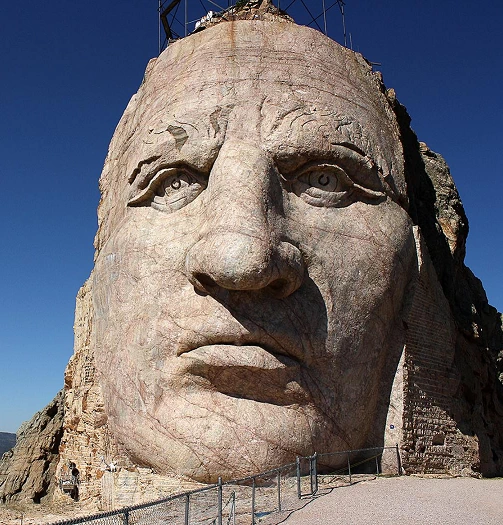
In the Black Hills of South Dakota, the construction of one of the world's largest sculpture projects has been ongoing for decades. When completed, the Crazy Horse Memorial will surpass not only the nearby giant presidential faces of Mount Rushmore but almost every known statue in the world in terms of scale. Started in 1948, this project is still under construction today, making it one of the longest-running sculpture projects in the world. The finished version of the sculpture will depict Crazy Horse on his horse, with his left arm extended and pointing toward the horizon. This pose carries a deep meaning in Lakota culture, referring to Crazy Horse's words: "My lands are where my dead lie buried."
Who is Crazy Horse?
Crazy Horse was born around 1840 to a family from the Oglala Lakota tribe. His exact date and place of birth are unknown; this uncertainty applies to much of the historical information about him. It is known that he refused to have his photograph taken throughout his life; therefore, no definitive visual record of his appearance exists. This mystery is one of the most characteristic features that distinguishes Crazy Horse from other Native American leaders and further deepens his legend.
Crazy Horse went down in history for the armed struggle he waged to defend the rights and lands of Native Americans. He won his first major notable victories with the military genius he displayed in clashes along the Bozeman Trail in Northern Wyoming between 1866 and 1868. However, the moment that immortalized his name is the Battle of the Little Bighorn, which took place on June 25-26, 1876. Conducted in coordination with Sitting Bull against U.S. Army forces under the command of General George Custer, this battle went down in history as one of the greatest military victories of Native Americans against the United States army. Custer and the troops under his command were completely annihilated; this result created a massive shock across all of America.
The Story of the Memorial and Korczak Ziolkowski
The story of the Crazy Horse Memorial cannot be told without the Polish-American sculptor Korczak Ziolkowski. Ziolkowski came to the Black Hills in 1948 at the invitation of Lakota chief Henry Standing Bear. Standing Bear's message was clear: "We would like the red man to know that the white man has heroes too." This invitation started a project to which Ziolkowski would dedicate his life. Rejecting government funding, Ziolkowski decided to finance the project solely through private donations and visitor revenue; this stance became the primary guarantee of the monument's independent and non-commercial character.
Ziolkowski passed away in 1982; however, his family continued to carry on the project. Today, his children and grandchildren are in charge of the construction. Following the completion of the face, the carving of the horse and the body continues. The Crazy Horse Memorial is shaped with the vision of becoming not just a sculpture project but also an educational and cultural center. Establishing a university and medical school dedicated to Native American history and culture is also among the project's long-term goals. This vision aims to take the memorial beyond an ordinary tourist site and turn it into a living center of Native American culture.
Importance of the Sculpture and Controversies
The Crazy Horse Memorial offers an extremely impressive experience for visitors. Drawing approximately one million visitors each year, this area is one of South Dakota's most important tourist destinations. Nightly laser shows and the "Volksmarch" organized twice a year offer visitors the chance to see the monument up close. The size of the face, carved out of the mountain, is impressive enough to almost stun the viewer at first sight.
However, the memorial is not free from controversy. Some Lakota Sioux communities and Native American activists argue that the Black Hills are sacred lands for the Lakota people and that carving this mountain is culturally unacceptable. Considering that Crazy Horse was known as someone who refused to have his photo taken and valued his private life immensely, questions arise as to what it means to represent his image on such a massive scale. In this context, the Crazy Horse Memorial has become a symbol of the fine line between respect and appropriation, and between honoring and violation.
Crazy Horse's Legacy Today
Crazy Horse was killed with a bayonet by a soldier shortly after his surrender at Fort Robinson in 1877, while he was only in his thirties. The circumstances of his death are still a subject of debate. The location of his grave is also not precisely known; this mystery adds one final layer to his legend. Today, Crazy Horse is remembered as a symbol of the Native American resistance movement, land rights, and the struggle for cultural identity. His memorial in South Dakota is both the largest and most controversial expression of this legacy. The mountain takes a little more shape every year; and with every new layer, both the story of Crazy Horse and the responsibility of telling this story grow heavier.
Date Added: