Captain Cook Statue - Sydney Australia
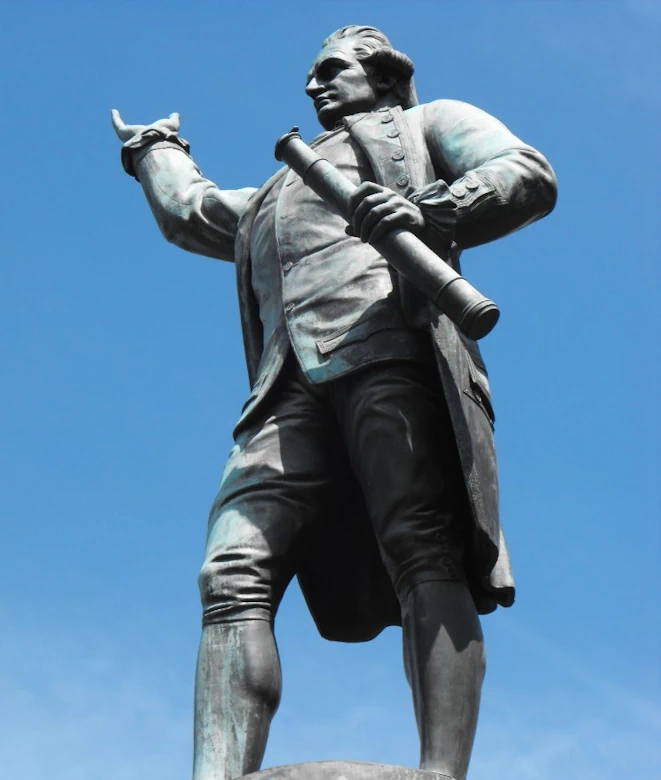
When you walk from Sydney’s Hyde Park toward the shore, amidst the cosmopolitan crowd of Circular Quay, you encounter the bronze figure of James Cook at a point overlooking the harbor. This statue, depicting the 18th century's greatest explorer-navigator looking toward the horizon with navigation instruments in hand, portrays the man who introduced the Australian coasts to the European world. However, the Captain Cook Statue in Sydney is not merely a historical reminder; it is the focal point of the complex relationship Australia has built with its own founding story, the deep tension between the narrative of discovery and the reality of colonization, and the question of whose history is being told and how. Few statues worldwide have been the target of such harsh and legitimate criticism; this makes Cook and the statue dedicated to him more controversial today than ever before.
Who is James Cook?
James Cook was born in 1728 in the Yorkshire region of England to a modest farming family. This exceptional self-taught sailor became one of the best names of his time in the fields of cartography, navigation, and astronomy. Rising through the ranks of the Royal Navy, he commanded three major Pacific expeditions: carried out between 1768–1771, 1772–1775, and 1776–1780, these voyages radically transformed Europe’s knowledge of Pacific geography.
On his first voyage, Cook reached the eastern coast of Australia in 1770 and dropped anchor at Botany Bay. He proceeded along the coast, drew maps, and declared a claim to the land on behalf of Great Britain. This action formed the cornerstone of the colonization of Australia that would take place within the following eighteen years. Without Cook's discovery, the establishment of the first European colony in 1788 would either not have happened so quickly or would have followed a completely different route.
Physical Characteristics and Artistic Language of the Statue in Sydney
The Captain Cook Statue in Sydney is a monument located near the southern end of Hyde Park and is considered one of the classic examples of Australian sculptural history. The statue was created by Thomas Woolner and unveiled in 1879; this date coincides with a period near the completion of Australia's first century.
Woolner’s Cook is one of the most powerful examples of British monumental sculpture of the period. The figure is depicted on a high pedestal, standing full-length, dressed in uniform. Cook holds a telescope or navigation instrument in his right hand; this object symbolizes his defining identity—the act of seeing and discovering by the sailor-explorer. With his left hand resting slightly on his hip, his head is turned forward and a bit upward; as if searching for something yet undiscovered on the horizon. This pose captures Cook in a state of constant discovery, precisely at the peak of his exploration.
The pedestal is constructed from granite or a similar stone material, and its height is calculated to make the figure visible within the urban fabric. The inscription on it conveys Cook’s name and a historical summary explaining his claims over the Australian coasts. The decorative elements at the corners of the pedestal reflect the characteristic ornamentation style of Victorian-era monumental sculpture: seashells, rope motifs, and figurative elements related to seafaring form a cohesive composition.
Woolner adopted a balanced style between realism and idealism. Cook's face is based on a recognizable portrait; this face, which bears a visual resemblance to depictions of Cook from the period, gives the statue historical rather than fictional weight. Nevertheless, the figure's posture is idealized; the understanding of heroic statuary of that time transforms an ordinary human body into a historical symbol. The tension between these two trends is a significant part of the statue’s aesthetic uniqueness.
A Historical Tour Following Cook’s Footsteps in Sydney
The Captain Cook Statue in Sydney is highly suitable as a starting point for exploring the city’s historical layers. Going from there to Botany Bay—the place where Cook first landed in 1770—brings abstract history together with a concrete geography. Botany Bay National Park houses a museum and information boards interpreting this historic landing.
In central Sydney, the Australian Museum’s extensive Aboriginal culture collection offers a powerful context that recounts both the civilization that existed on these lands before Cook’s arrival and the transformation that occurred afterward. While the Hyde Park Barracks Museum exhibits the architectural and social history of the colonial period, the Rocks district is an area where the streets of Australia’s first colonial settlement are preserved, and history is felt almost poignantly. The Captain Cook Statue is the focal point of this broad picture; but its true meaning emerges when read together with this rich context surrounding it.
Date Added: