Aung San Statue – Myanmar – Yangon
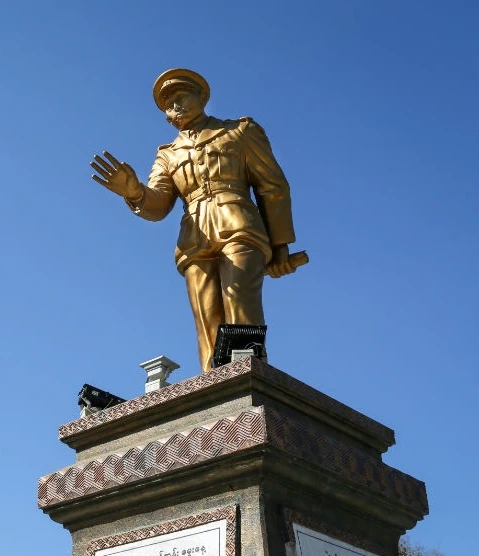
Walking through the streets of Yangon, Myanmar's largest city, where history is embedded in every corner, you pause at a certain point: before you rises a figure that symbolizes decades of struggle, blood, tears, and ultimately the hope for freedom. The Aung San Statue is the most visible expression of Myanmar's independence struggle and national identity. General Aung San gave his life so that his country could win freedom from British colonial rule; yet before he could savor that freedom, with independence only months away, he fell victim to an assassination. His unfinished story continues to live on in the collective memory of the Myanmar people as a deep wound and, at the same time, a powerful source of inspiration. His statue in Yangon is the most silent yet most powerful narrator of this unfinished story.
General Aung San's Life and Struggle
Aung San was born in 1915 in the town of Natmauk, Myanmar. His political consciousness developed rapidly during his years studying law at Rangoon University, and he quickly became one of the prominent figures of student movements. Stepping into political life with the organization known as Dobama Asiayone (We Burmans Association), Aung San gradually became the most charismatic and most influential figure of Myanmar's independence movement. The heavy responsibility he carried at such a young age was the clearest proof that he was an extraordinary leader.
In a process shaped by the shadow of the Second World War, Aung San first sought Japan's support and received military training. Aung San, who trained in Japan with a small but determined group that went down in history as the Thirty Comrades, subsequently founded the Burma Independence Army. This army, which helped the Japanese take Myanmar from the British, initially appeared to be a promising instrument for independence. However, as the true face of Japanese dominance in the region became clear, Aung San changed his strategy and took a stand against the Japanese by cooperating with the Allied forces. This strategic turn also revealed that he was not merely a military commander, but an exceptionally pragmatic and sharp politician.
After the war, Aung San conducted intensive negotiations to win Myanmar's independence from the British. The Aung San-Attlee Agreement, signed with the British government in London in 1947, removed the greatest legal obstacle standing in the way of Myanmar's independence. Independence was now only months away. However, Aung San never witnessed this historic moment; on July 19, 1947, he was killed in an armed attack during a cabinet meeting, along with the other ministers beside him. On that day, Myanmar lost not only a leader, but also a vision capable of shaping its future.
Maha Bandula Park and the Location of the Statue
Located right in the center of Yangon, close to the ruins of the Royal Palace and the historic Sule Pagoda, Maha Bandula Park is one of the city's most important public spaces. Surrounded by colonial-era architecture, this area covered with British-period buildings, wide boulevards, and tropical trees contains different layers of history side by side. The Aung San Statue rises right beside the Independence Monument, the most eye-catching element of this park.
The location of the statue is no coincidence; it is a deliberate symbolic choice. Its placement side by side with the Independence Monument also spatially emphasizes Aung San's central role in the independence process. The cohesion created by this combination with the other elements within the park offers visitors an open-air museum experience that narrates Myanmar's independence story step by step. From elderly people taking morning walks in the park to young people sitting and chatting in the late afternoon, Maha Bandula Park is the meeting point for every segment of Yangon's population.
The Artistic and Symbolic Features of the Statue
The Aung San Statue depicts the General in military uniform. This choice is not coincidental; it reflects the fact that Aung San's role in Myanmar's history is identified primarily with the identity of a military leader and commander. The figure's posture is designed to simultaneously convey determination, self-confidence, and the authority of leadership. The inscriptions on the Statue Pedestal provide information about the key moments of his life and Myanmar's independence struggle. The material choice of the statue and its craftsmanship are conceived in a way that foregrounds the sense of permanence and honor.
The symbolic power of the statue does not stem solely from its physical characteristics. Aung San's place in Myanmar society runs so deep that standing before his statue means more than visiting a monument. For elderly Myanmar people, this statue symbolizes a lost father, a dream left unfinished. For the younger generation, it is the materialized form of independence ideals and the struggle for freedom. This multi-layered meaning carries the statue far beyond an ordinary monument.
Tourism and the Historic Fabric of Yangon
Yangon is one of Southeast Asia's most distinctive and least known cities. In this city where colonial-era architecture, gold-covered pagodas, and bustling street markets are all intertwined, the Aung San Statue is also an extremely important stop from a touristic standpoint. The great majority of visitors to the city choose Maha Bandula Park and the Aung San Statue as their second stop after Shwedagon Pagoda. The area surrounding the statue also offers an exceptionally rich visual environment for photography enthusiasts; historic buildings, tropical trees, and the magnificent silhouette of the monument together create breathtaking compositions.
Date Added: