Antoine Pevsner - Russian Sculptor
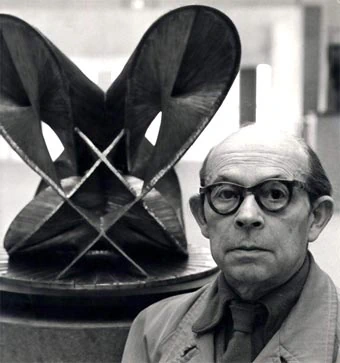
Antoine Pevsner, who played a decisive role in bringing Constructivism—one of the most important abstract art movements of the 20th century—to the international arena, was born in 1886 in Klimovichi, Russia. The Realistic Manifesto, which he published with his brother Naum Gabo in 1920, constituted one of the most critical turning points in the history of modern sculpture and brought a radical redefinition to the expressive tools of art. Pevsner advocated that art should relate not only to surface and color but also to the concepts of space, time, and movement. This thought made him a key figure in shaping the 20th-century understanding of sculpture, both as an artist and a theorist. This intellectual and artistic adventure that began in Russia moved to Western Europe in the following years and left deep traces there as well.
Artistic Identity and Place in Constructivism
At the core of Pevsner's understanding of art lies the desire to transcend the limits of traditional sculptural materials and forms. Bringing together materials such as bronze, copper, and plastic in unusual ways, Pevsner rejected solid masses and made space and transparency integral components of his sculpture. There are no flat surfaces in his works; every form consists of a dynamic integrity of curved and linear elements in dialogue with each other. This approach takes sculpture from being a static object and transforms it into an experience that takes on different forms, changes, and transforms as the viewer moves around it. For Pevsner, sculpture was not a moment, but a process.
Pevsner, whose artistic paths occasionally diverged and intersected with his brother Naum Gabo, brought to life the common principles stated in the Realistic Manifesto through his own style. The principle that "art should be life itself rather than representing life," one of the most fundamental arguments of the manifesto, served as a consistent guide throughout Pevsner's entire production. This principle offered a perspective that forced him to reckon not only with the aesthetic but also with the philosophical and social dimensions of art.
Years in France and International Recognition
Leaving the Soviet Union in 1923 to settle in Paris, Pevsner deepened both his production and international influence there. The relationships he established with the Paris art scene and his role as one of the founding members of the Abstraction-Création group positioned him as one of the most central figures of European abstract art. Taking French citizenship in 1930, Pevsner continued to work in Paris until his death, and over time, his works began to find a place in the world's most prestigious collections, most notably the Centre Pompidou. His Paris years played a decisive role in ensuring that Constructivism did not remain merely a Russian movement but gained a universal language.
Lasting Contribution to the Art of Sculpture
Antoine Pevsner's most lasting contribution to the art of sculpture is his mastery in building the bridge that meets abstract form with human experience. Making the concepts of space, movement, and time inseparable parts of the language of sculpture prepared a highly productive ground for subsequent generations of artists. A viewer standing in front of Pevsner's works does not just see an object; they also experience the space around that object, the way light refracts on metallic surfaces, and how the form changes from different angles. This multi-layered experience makes him one of the most original and enduring voices of 20th-century sculpture.
Date Added: