Andrés Bonifacio Statue – Philippines Manila
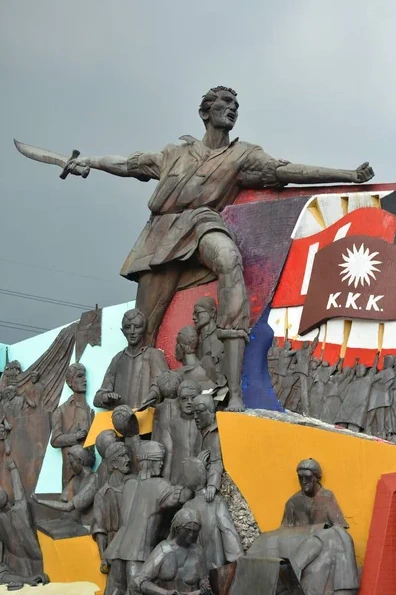
Rising majestically in Caloocan City, part of the Metro Manila region near the Philippine capital, this magnificent monument is dedicated to one of the most pivotal figures in Philippine independence history. Andres Bonifacio founder and "Supremo" of the Katipunan, the secret revolutionary society that launched the armed uprising against Spanish colonial rule was born on November 30, 1863, in Tondo, Manila. He is remembered in history as the "Father of the Philippine Revolution." Caloocan is home to a world-renowned monument that keeps his name and legacy alive. The sculpture has become an unmissable stop for history enthusiasts and tourists visiting the area.
Construction History of the Monument
The Andres Bonifacio Monument was designed by Guillermo Tolentino, a Filipino sculptor honored with the title of National Artist. Legislation authorizing its construction was passed in 1918, and the cornerstone was laid on November 30, 1929 Bonifacio's 66th birthday by Aurora Quezon, wife of the Senate President at the time. Commissioned by American Governor-General Frank Murphy, the monument was completed after four years of work and officially unveiled on November 30, 1933, during celebrations marking Bonifacio's 70th birthday. The bronze figures were cast at the Marinelli Foundry in Italy, while the winged victory figure at the apex was manufactured in Germany. The total sculpture cost reached 125,000 Philippine Pesos an astronomical sum for the era and represents the crowning achievement of Tolentino's career.
Artistic Features and Design Details
The monument is a complex sculptural ensemble centered on a 13.7-meter-tall obelisk. The obelisk is composed of five sections, each symbolizing one of the five core values encoded in the full name of the Katipunan. A winged figure of victory crowns the top. More than 20 bronze figures surrounding the octagonal base depict Bonifacio, Emilio Jacinto, Katipuneros, and the three martyred Filipino priests known as GomBurZa. Each face of the octagonal base represents one of the eight Philippine provinces that rose up against Spain. The three steps leading up to the base symbolize Spain's 333 years of colonial rule. The figure of Bonifacio stands resolute holding a pistol in one hand and a bolo (a traditional Philippine blade) in the other gazing outward with determination.
Location: Caloocan and Surroundings
The monument stands in southern Caloocan City, at the major intersection of EDSA (Epifanio de los Santos Avenue), MacArthur Highway, Samson Road, and Rizal Avenue. The location carries deep symbolic significance: Caloocan is the historic birthplace of the 1896 Philippine Revolution and the site where the Katipunan first clashed with colonial forces. The monument stands just steps from "Monumento Station," the northern terminus of LRT Line 1 (Light Rail Transit), making it easily accessible from anywhere in the city. The intersection has long been known simply as "Monumento" among locals.
The Legacy of Andres Bonifacio
Andres Bonifacio developed his political consciousness as the child of a poor working-class family in Manila. In 1892, he founded the Katipunan and launched an organized armed struggle against Spanish colonial rule. The revolution officially began on August 23, 1896, when Katipunan members publicly tore their tax certificates an act of defiance that became known as the "Cry of Pugad Lawin." However, a power struggle within the revolutionary movement ultimately sealed Bonifacio's fate: defeated by the rival faction led by Emilio Aguinaldo, he was executed on May 10, 1897. This tragic end has cemented Bonifacio's place in Philippine history as both a revered hero and a complex, debated figure. Every year on November 30, "Bonifacio Day" is observed as a national public holiday.
Visitor Information
The Andres Bonifacio Monument is located in Caloocan City, Metro Manila, at the intersection of EDSA and MacArthur Highway. It is within walking distance of Monumento Station on LRT Line 1. The monument stands in a public open space at the center of the intersection, making it freely visible from the street year-round at no cost. Special celebrations and ceremonies are held in the surrounding area every November 30 on Bonifacio Day.
Date Added: