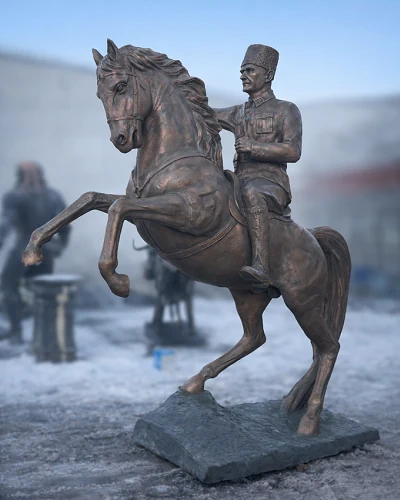
Video showing the detailed making process of the Atatürk sculpture. ()
The Ataturk monument sculpture you watched in our video is one of the most important works of Turkish sculpture art. In this video, you can watch step by step how our sculptor shapes Ataturk's facial features. One of the most critical stages of creating a realistic portrait is the correct modeling of facial anatomy. Ataturk's determined gaze, strong jaw structure and characteristic features are worked with millimeter precision by experienced hands. Every detail has been meticulously studied based on historical sources and archive photographs.
The techniques used during the modeling of facial expressions include modern approaches as well as classical sculpture training. Our sculptor first determines the general forms while working on clay material, then clarifies the distinctive lines such as eyes, nose, and mouth. This work, which takes into account light-shadow plays, ensures that the sculpture looks impressive from every angle. The sense of leadership and determination in Ataturk's expression is reflected by giving it a spiritual depth beyond mere physical resemblances.
Expertise in Professional Sculpture Making Process
The techniques shown in the video are the result of years of training and practical experience. Facial anatomy is one of the most complex parts of the human body, and each face has its own characteristic features. A professional sculptor not only observes to capture these features, but also knows how to shape the material, which tools to use, and when to add detail and when to stay in general form. This video is a valuable resource for both art enthusiasts and those interested in sculpture making.
Face Modeling Techniques in Realistic Sculpture Art
Making a realistic portrait sculpture is one of the most challenging branches of art. The human face is the most important tool that reflects our emotions and personality. Therefore, when turning a face into a sculpture, it is necessary to capture not only the physical features but also the spirit of that person. The nobility and determination in Ataturk's face, when modeled correctly, leaves a strong impact on the viewer. Our sculptor uses both his anatomical knowledge and artistic intuition to reveal this expression.
Hello, good work. I can't wrap my head around how you shape a human face with that knife-like tool in your hand. It must be a job that requires a special and unique talent. I watched your videos and I'm expecting more. I especially want a video from you starting from the very beginning of how a statue is made. There are many different versions of Atatürk statues. May your hands never see trouble.
Ataturk's facial features begin by establishing the general form. The sculptor works on clay material, creating the skull structure and basic proportions. Then distinctive lines such as forehead, cheekbones and jaw are clarified. Important elements such as eyes, nose and mouth are worked with anatomical accuracy and adherence to historical sources. Every detail is worked with millimeter precision and light-shadow plays are taken into account. Ataturk's characteristic features such as strong gaze, determined expression and leadership aura are reflected.
Ataturk's face modeling varies depending on size and level of detail. While the facial part for a small bust can take 3-5 days, face details in equestrian monument sculptures like in the video may require 2-3 weeks of work. This time depends on the sculptor's experience, techniques used and desired level of realism. Facial anatomy is the most complex part of the human body and correct modeling of each expression muscle takes time. Comparison with historical sources, corrections and fine adjustments are also important parts of this process.
The technique used in the video is the direct clay modeling method that forms the basis of classical sculpture tradition. The sculptor works on plastic clay, first creating large masses, then moving to details. Shaping is done by adding and subtracting. Smoothing operations are performed with various spatulas, wooden tools and fingers. Keeping the material moist is critical in this technique because clay becomes difficult to work with when it starts to dry. Delicate touches and anatomical knowledge come together in face modeling. Light sources are controlled from different angles to test form accuracy.
The video shows the facial detailing stage of the equestrian Ataturk monument sculpture. This is one of the most critical phases of the sculpture because the general form has been previously completed and now fine details are being worked on. The sculptor is clarifying Ataturk's characteristic facial features, deepening eye sockets and modeling expression muscles. This stage is the transition point from rough work to professional finish. In subsequent stages, mold making and bronze casting processes will be performed. Since the success of the entire sculpture will be affected if the face details are not done correctly, this stage requires great care.
The sculptor uses various special tools during face modeling. Metal and wooden spatulas in different sizes and shapes are critical for detail work. Loop tools are used to clean excess clay and open cavities. Fingers are indispensable for smoothing and final touches. Modeling stylus helps process fine lines and eye details. Sponges and brushes are used to smooth the surface. Water container keeps the clay moist. Measuring tools check the accuracy of proportions. Professional sculptors gain mastery by using these tools for years and know how to use each tool at which stage.
Yes, historical photographs are definitely used in making the Ataturk sculpture. Our sculptor models the facial features correctly by examining archive photographs taken from different angles. Ataturk's profile view, front view and photographs taken from quarter angles are used as reference in determining anatomical proportions. Official portraits and documentary footage from the period are also utilized. These photographs are used not only for physical resemblances but also to reflect Ataturk's expression, posture and character. The balance of historical accuracy and artistic interpretation is achieved in this way.