What is Relief
Relief is a fascinating discipline that showcases the dance of art with the surface in its most concrete form, as one of the oldest modes of expression in human history. The term, which originates from the French word "relief" and is translated as "kabartma" in Turkish, is based on the principle of bringing figures or patterns to the forefront by creating a certain depth on a flat surface. Not only does relief offer a visual feast, but it also appeals to the sense of touch, creating a perception of depth that draws the art lover into the work. Although considered a sub-branch of the art of sculpture, Wall sculpture relief becomes a vast world of its own with its unique rules, techniques, and areas of application. Today, this art, which we encounter in a wide range from the walls of ancient temples to the decoration of modern homes, continues to immortalize the stories of the past in stone while shaping the aesthetic understanding of the future.
The Historical Journey of Relief Art
The story of relief begins with the first sparks of the human desire to express oneself. This journey, extending from simple figures carved into cave walls to the magnificent palaces of ancient civilizations, actually symbolizes the development of civilization. In the Ancient Egypt period, relief was the most powerful tool for storytelling, especially on temple and tomb walls. The Egyptians masterfully used the "sunken relief" technique to immortalize the lives of pharaohs and their devotion to the gods. The details in these works provide us with priceless information about the social structure and belief systems of that period.
In the Mesopotamian geography, Assyrian and Babylonian artists displayed their power by carving battle scenes and hunting parties onto massive stone panels. The reliefs of this period are works that carry the quality of a documentary, where anatomical details and a sense of movement come to the fore. When it came to the Ancient Greek and Roman periods, relief art experienced its golden age. The friezes of the Parthenon Temple or the carvings on Trajan's Column are masterpieces where the human figure was idealized and the perception of perspective was perfected. In the Middle Ages, relief, an inseparable part of church architecture, evolved into a point where depth and shadow plays reached their peak with the Renaissance. Masters like Donatello and Ghiberti made relief as detailed and deep as a painting with the scenes they carved onto bronze doors.
What are the Types of Relief?
Relief art is divided into three main categories depending on how much it rises from the surface or how it is processed onto the surface. This diversity determines the intensity of the message the artist wants to convey and the characteristics of the area where the work will be exhibited.
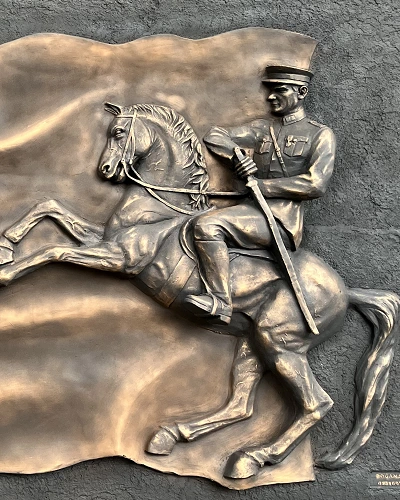
Low Relief (Bas-Relief): A technique where figures rise very little from the surface. The perception of depth is quite limited and is generally preferred for coins, medallions, or wide wall surfaces. Light and shadow plays are of vital importance in this technique; because the depth is low, the clarification of forms depends on the angle of the light.
High Relief (Haut-Relief): A technique where figures protrude significantly from the surface, sometimes even appearing as if they are about to break away from it. In such works, more than half of the figures are outside the surface. High relief evokes a strong sense of three-dimensionality in the viewer and is generally used in monumental structures and exterior decorations.
Sunken Relief: Unlike other techniques, it is created by carving the figures into the surface instead of raising them from it. This technique, frequently encountered especially in Ancient Egyptian art, ensures that figures are seen very clearly thanks to the harsh shadows created by sunlight in outdoor spaces.
Materials and Techniques Used
The applicability of relief art is directly proportional to the variety of materials used. Traditionally, stone, marble, and wood are the most commonly used materials. While stone reliefs are preferred for outdoor spaces due to their durability, wood reliefs find a place in interior decoration thanks to the warmth of the material. Especially trees like walnut, oak, and linden are very suitable for detailed carvings. You can review our Materials used in sculpture making page.
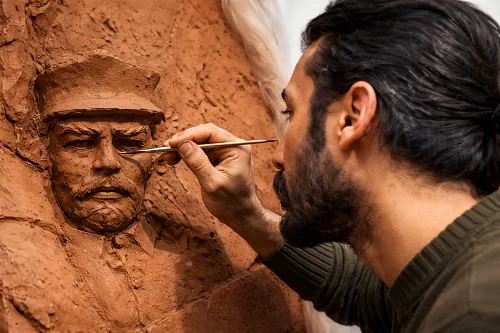
In the modern period, materials such as plaster, clay, metal, and even paper have added new dimensions to relief art. Plaster reliefs are frequently used in ceiling and wall decorations due to their suitability for mass production through the molding technique and their lightness. Metal reliefs, on the other hand, are generally prepared with forging or casting techniques and provide an aesthetic touch in industrial designs. The material chosen by the artist also determines the tools they will use. Chisels, hammers, carving knives, and modeling pens are a relief artist's most faithful friends.
Paper Relief and Architectural Applications
Paper relief, which has attracted great interest in the hobby world in recent years, is a modern interpretation of traditional relief art. This technique is based on the principle of pasting multiple copies of the same image on top of each other with a certain order and understanding of perspective. Thanks to the elevating materials placed between the layers, the image transforms from a two-dimensional piece of paper into a three-dimensional painting. The most important element in paper relief is patience and attention to detail.
Relief has been the most faithful complement to architecture throughout history. The geometric patterns and floral motifs we see in Seljuk and Ottoman architecture are the most beautiful examples of how stone can be processed like lace. The muqarnas and reliefs on the portal gates increase the magnificence of the structure while also reflecting the aesthetic understanding of the period. Today, relief is frequently preferred for creating "accent walls" in interior design. Textured walls made using relief paste techniques add movement to modern decorations.
Date Added: | Last Updated: