Placement and professional installation of monumental sculptures
Fixing large-scale sculptures to the ground is not merely a matter of aesthetic placement. This task is also a significant issue of engineering and safety. Improperly securing works that can reach hundreds of kilograms in weight brings the risk of toppling due to earthquakes, wind, or human contact, threatening both the safety of the artwork and the people around it.
Securing Large-Scale Works to the Ground
The first step before starting the fixing process is soil analysis and load-bearing capacity calculation. Any intervention performed without knowing whether the ground can support the weight of the work is risky. Soft, damp, or filled ground can cause sinking and tilting over time. Therefore, a ground survey must be conducted for large-scale installations, and ground reinforcement should be planned if necessary.
Anchoring Systems and Application Methods
The most common fixing method is the anchoring system. The base of the sculpture is locked to the ground through steel rods or plates embedded in concrete. In the chemical anchoring method, an epoxy-based filler is used to secure the steel rod within the concrete; in mechanical anchoring, fastening is achieved through an expanding sleeve system. Chemical anchoring generally provides a stronger bond but presents much more difficulty compared to mechanical anchoring if removal is required in the future. The choice of method is determined by the soil structure, the weight of the work, and whether it will be moved in the future.
Center of Gravity Calculation and Overturning Risk
A sculpture that appears stable can easily topple under unexpected conditions if secured without a correct center of gravity calculation. The overturning moment should be calculated by proportioning the distance of the center of gravity from the ground to the width of the base. This calculation is critically important, especially for sculptures where the upper part is heavier than the base. Wind load must also be included in this calculation; the lateral force created by wind cannot be ignored for large-surface works placed outdoors.
Pedestal Design and Structural Function
The pedestal beneath the sculpture is not just an aesthetic element; it is also a structural component that balances weight distribution. If the loads on the pedestal are not distributed evenly, cracks can form on the concrete surface, leading to the loosening of the fixing over time. The pedestal material is also important in this regard; porous or low-density concrete can freeze and crack in high-humidity conditions. Granite and high-strength concrete are among the most preferred materials for outdoor pedestals.
Durability Against Earthquake and Climate Conditions
In regions with earthquake risks, fixing systems must go far beyond standard calculations. Horizontal forces transmitted to the work under earthquake loads can be much larger than the vertical weight load. Special seismic isolators used in such regions absorb the effect of the earthquake and reduce the force transmitted to the work. Additionally, all metal fasteners used in outdoor fixings exposed to freeze-thaw cycles must be stainless steel or galvanized; otherwise, corrosion will weaken the connection points over time.
Removability and Future Relocation Possibility
When performing the fixing, the possibility of future removal should also be considered. Especially for works placed in temporary exhibition areas or private collections, reversible fixing details should be designed from the start. A work installed with permanent chemical bonds will present great difficulty and may even be damaged if it needs to be moved. Therefore, even in seemingly permanent installations, a specific dismantling plan should be prepared in advance and kept documented.
Fixing large-scale works to the ground is a comprehensive process requiring engineering calculations, material selection, and long-term planning. When this process is managed correctly, the work stands safely in place for decades. When mismanaged, serious risks arise for both the artwork and its surroundings. Therefore, obtaining expert support for large installations is not a choice, but a necessity.
Different surface types such as concrete, asphalt, stone paving, granite coating, and soil ground can be used in sculpture installation. Each type of ground requires different fixation methods according to its own structural characteristics. While a strong connection is provided with chemical anchoring or mechanical dowel systems on concrete and granite surfaces, the ground is first strengthened by foundation concreting on soil surfaces. Determining the ground type is one of the most critical steps of the technical inspection carried out before installation. Correct ground analysis guarantees that the sculpture remains safe and stable for many years.
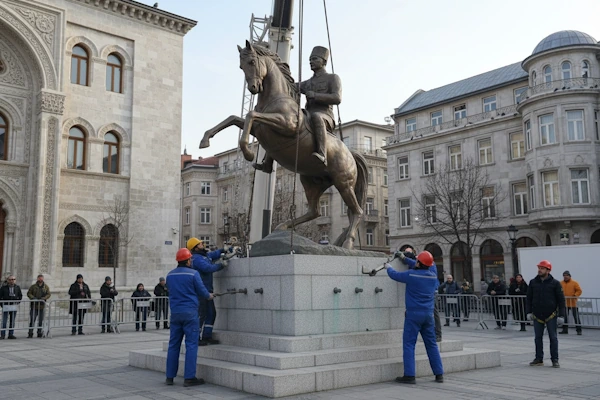
For heavy and large-scale works such as equestrian sculptures, fixation is carried out with special anchoring systems based on engineering calculations. Steel anchor bolts placed between the sculpture's base and the ground are fixed deeply into the ground using chemical or mechanical methods. The number and depth of anchor points are determined by calculating the total weight, center of gravity, and wind load of the sculpture. The connection points between the base and the sculpture are also processed with the same care, securing the entire structure as a whole. This process is carried out by an experienced technical team with appropriate equipment.
Yes, ground analysis is an indispensable preliminary preparation stage in large-scale sculpture installations. Our installation team evaluates the load-bearing capacity, structural characteristics, and current condition of the ground by conducting an on-site inspection. This analysis is used as the primary data source for determining the fixation method to be applied, the anchor depth, and if necessary, additional ground reinforcement work. Installations carried out without ground analysis can lead to stability problems, subsidence, or tilting risks in the long term. The ground analysis process is carried out meticulously for a safe and permanent installation.
The connection between the sculpture base and the ground is provided by different technical methods depending on the material used and the type of ground. The most commonly used method is fixing steel anchor bolts placed deep into the ground with chemical mortar or epoxy resin. The base is precisely seated on these anchor points and locked with a bolt and nut system. When necessary, special filling materials providing water and moisture insulation are applied under the base. All connection points are checked by the technical team after installation to confirm that they meet safety standards.
The use of a crane and heavy transportation equipment is mandatory for the installation of large-scale and heavy sculptures. Safely lifting, transporting, and precisely placing these works, which can reach tons in weight, onto the base is only possible with professional crane systems. The crane capacity is calculated in advance according to the weight and dimensions of the sculpture, and the appropriate equipment is selected. The suitability of the installation area for crane access is also evaluated during the site inspection. All lifting and placement operations are managed by an experienced team in accordance with occupational safety standards.
The duration of the ground fixation process varies depending on the size and weight of the sculpture, ground conditions, and the fixation method applied. For a standard-scale sculpture, the fixation process can generally be completed within a single working day. However, for large and heavy works such as equestrian sculptures, the process may extend over several days, including ground preparation, anchor application, and curing time. The waiting time required for the mortar or resin used in chemical anchor applications to fully harden is also included in the total installation schedule. The exact duration is shared with you by our technical team after the site inspection.