
How Can Historical Artifact Treasure Sculpture Be Identified?
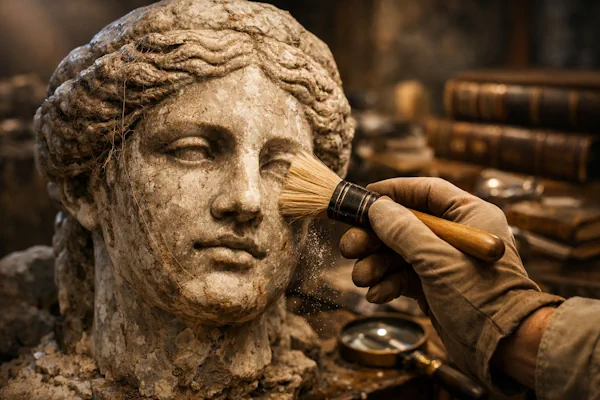
In our country, trade in historical artifacts, treasure hunting, and excavation activities are subject to legal permission under the Law No. 2863 on the Protection of Cultural and Natural Assets. This content has been prepared purely for informational purposes for those curious about how historical artifacts are identified. As Heykel.org, our field of activity is the production of original sculptures from scratch, and we have no connection whatsoever with historical artifacts, treasure, or excavation activities. The information shared here is intended solely for general culture and educational purposes.
What Is a Historical Artifact?
Historical artifacts are objects that have survived from the past and carry cultural, artistic, or historical value. Ceramics, weapons, jewelry, sculptures and written documents are among the main examples in this category. For an object to be considered a historical artifact, it must belong to a specific period and reflect that era. Making this determination without expert examination is extremely difficult.
What Is Treasure?
Treasure is commonly defined as valuable items or money buried in the ground or hidden somewhere. It is known that throughout history, people hid their valuables during wars, migrations, or periods of famine. To conduct treasure hunting on a legal basis, official permission from the Ministry of Culture is mandatory. Those who search for treasure without permission may face severe legal sanctions.
How to Identify a Historical Artifact?
There are several basic methods to determine whether an object is truly a historical artifact. First, the material, craftsmanship, and wear marks on the object are examined. Genuine antique artifacts show natural signs of aging; in fakes produced with artificial aging techniques, these marks appear irregular and inconsistent. Additionally, scientific methods such as thermoluminescence, carbon-14, and XRF spectroscopy are used to determine age and material composition.
The Difference Between a Sculpture and a Historical Artifact
Not every sculpture is a historical artifact; however, every historical artifact may carry artistic value. For a sculpture to be considered a historical artifact, it must be at least one hundred years old and be evaluated within the scope of registered cultural heritage. Modern sculptures, although they carry artistic value, do not legally qualify as historical artifacts. All sculptures produced under Heykel.org are original works designed from scratch.
How to Identify a Fake Historical Artifact?
Fake historical artifacts are unfortunately quite common in the market. To understand whether an artifact is fake, the sales channel should first be considered. Items offered for sale without the approval of a reputable auction house or expert are most likely fake. Excessively shiny surfaces, uneven patina layers, and undocumented history are also among the signs of forgery.
What Should Be Done If Treasure Is Found?
According to Turkish law, even if an object with the nature of a historical artifact or treasure is found by chance, it is mandatory to notify the nearest museum directorate or gendarmerie unit. It is also legally recognized that the person who makes the report is entitled to a reward from the state. Failing to report the find constitutes a crime and may result in sanctions including imprisonment.
Historical Artifact Treasure Sculpture
Historical artifacts and treasure are sensitive subjects that must be handled carefully from both a historical and legal perspective. This content has been prepared solely to provide general information for curious and research-minded readers. At Heykel.org, our work is not to preserve historical heritage, but to produce new and original works of art. For more information about sculpture orders and art production, you can contact us.
Date Added: | Last Updated: