Vasco da Gama Statue – Portugal Lisbon
Portugal's capital Lisbon is an ancient city that carries the traces of great sailors who shaped world history. One of the brightest representatives of this heritage is Vasco da Gama, the explorer who was the first to reach India from Europe by sea. The Belém district of Lisbon holds immense symbolic and touristic significance as the very point from which he set sail on his historic voyage in 1497. Today this legendary district, with its statues, monuments and historic buildings housing Vasco da Gama's tomb, invites visitors into the Age of Discoveries.
Construction and History of the Statue
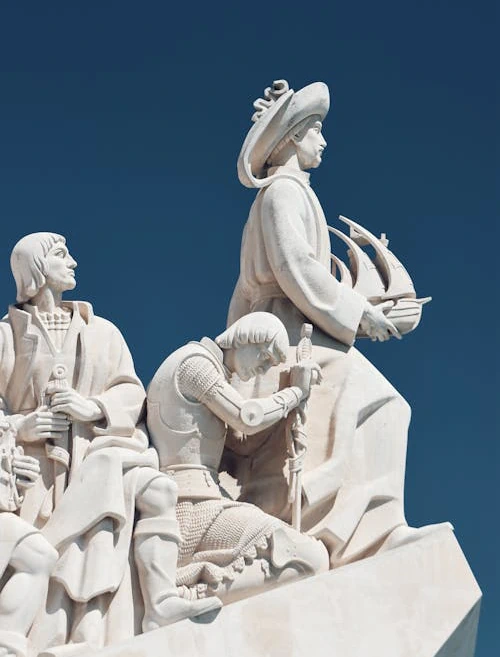
The monument in which Vasco da Gama features most prominently is the Monument to the Discoveries (Padrão dos Descobrimentos), which rises on the banks of the Tagus River in Lisbon's Belém district. This monumental structure was designed by Portuguese architect José Ângelo Cottinelli Telmo and sculptor Leopoldo de Almeida. The monument was first erected in 1940 as a temporary structure for the Portuguese World Exhibition, but was dismantled after the exhibition closed. On 3 February 1958, a decree was issued ordering the construction of a permanent monument, and work began in November 1958. Officially inaugurated on 9 August 1960 to mark the 500th anniversary of the death of Henry the Navigator, the monument was built using pink stone from Leiria and limestone from the Sintra region. The statues were also carved from the same Sintra limestone a material that forges a shared historic bond with the Jerónimos Monastery and the Belém Tower.
Features and Artistic Details of the Statue
Standing 56 metres tall and 46 metres long, the monument takes the form of a caravel's prow stretching out toward the Tagus River. At the very front stands the figure of Henry the Navigator, followed by King Afonso V kneeling, and then Vasco da Gama. Comprising a total of 33 figures, the monument brings together explorers, cartographers, missionaries, writers and artists. The Vasco da Gama figure is positioned on the eastern face of the monument, the side that looks out toward the open sea a placement of great significance, as that face points in the direction the explorers once departed, toward the mouth of the Tagus and the ocean beyond. In the square in front of the monument stands a 50-metre-diameter marble world map, a gift from the Republic of South Africa.
The Belém District and Its Surroundings
The monument is situated on the Belém waterfront, surrounded by historic landmarks including the Belém Tower, the Jerónimos Monastery and the Portuguese Maritime Museum. The Jerónimos Monastery holds particular significance: Vasco da Gama and his crew spent the night in prayer at the Santa Maria de Belém Chapel beside the monastery before setting out on their historic 1497 voyage. Inside the monastery's church, Vasco da Gama's tomb can still be visited today a historic landmark before which thousands of visitors bow their heads in reverence each year. Entering the monument itself, visitors encounter a three-level interior: the ground floor houses an auditorium presenting multimedia exhibitions on the history of Lisbon, while the upper floors contain exhibition halls. From the terrace, reached by elevator, a breathtaking panorama of the Tagus River, the Belém Tower and the Jerónimos Monastery unfolds.
The Legacy of Vasco da Gama
Vasco da Gama was born in 1460 in the Portuguese town of Sines. Setting sail from Lisbon on 8 July 1497 on the orders of King Manuel I, commanding four ships and 160 sailors, da Gama rounded the Cape of Good Hope at the southern tip of Africa and reached the port of Calicut in India in May 1498. This voyage bypassed the overland trade routes through the Ottoman Empire and opened an entirely new maritime trade route between Europe and Asia, rapidly transforming Portugal into the world's most powerful maritime empire. Vasco da Gama died in India in 1524; his remains were later brought back to Portugal and interred in the Jerónimos Monastery in Lisbon. The sea route he pioneered formed the backbone of global trade for centuries though historians also frequently note that this discovery simultaneously opened the door to colonialism and forced religious conversion.
Visitor Information
The Vasco da Gama Statue and Monument to the Discoveries are located in Lisbon's Belém district, on the banks of the Tagus River. From the city centre, they can be reached in approximately 7 minutes by tram line 15 or by train from Cais do Sodré. Admission to the monument is charged: a ticket for the exhibition, film and terrace costs 6 euros, while the exhibition alone is 3 euros. Between October and February the monument is open Tuesday to Sunday from 10:00 to 18:00, and from March to September every day from 10:00 to 19:00; it is closed on Mondays during the October–February period. When planning a visit, the nearby Belém Tower and Jerónimos Monastery should also be included in the itinerary.
Date Added: