Rachel Whiteread - British Sculptor
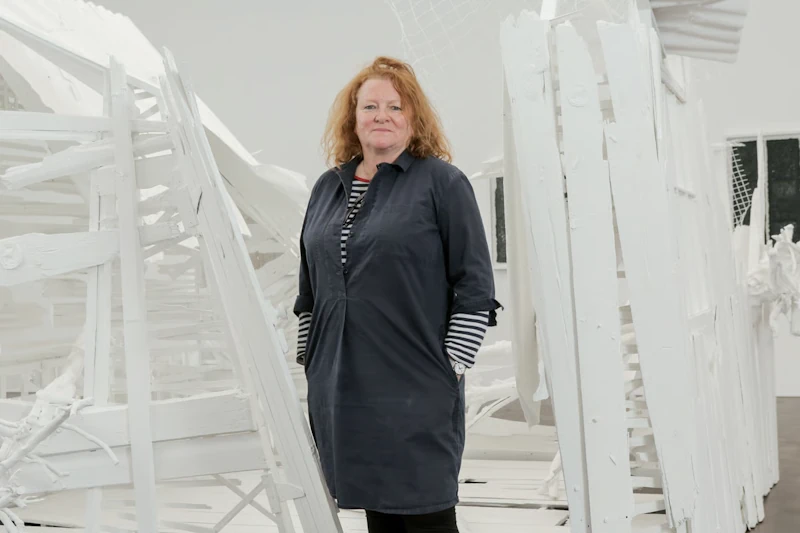
Rachel Whiteread, one of the most original and thought-provoking figures in contemporary art, was born in England in the second half of the 20th century and quickly established herself at the center of the international art world's attention. Her style of casting and solidifying the "negative spaces" of ordinary objects and spaces has earned her a unique position in the eyes of both art critics and the wider public.
Early Life and Education
Rachel Whiteread was born on April 20, 1963, in the Ilford district of London. Growing up in an artistic family, Whiteread developed her interest in the visual arts from an early age. After studying painting at Brighton Polytechnic, she went on to the Slade School of Fine Art in London, where she specialized in sculpture. Her training at the Slade played a decisive role in shaping her artistic identity; her deep interest in the concepts of space, memory, and place took root during these years.
Artistic Style and Approach
The most fundamental characteristic that sets Whiteread's art apart from others is her casting of negative spaces. Transforming the interior, underside, or surrounding void of an object into a concrete form has become her signature. Using sculpture materials such as plaster, resin, concrete, and rubber, the artist makes spaces overlooked in everyday life visible. The void beneath a bathtub, the space under a shelf, or the entire interior volume of a room are transformed in her hands into lasting and thought-provoking sculptures.
This approach produces works that profoundly affect the viewer on both a visual and emotional level. Whiteread's works offer a quiet yet powerful commentary on loss, memory, time, and the traces of human presence absorbed into spaces. The negative cast of an ordinary household object becomes, in her hands, an object that poses existential questions.
House: Her Most Talked-About Work
The turning point of Whiteread's career was the monumental installation titled House, realized in 1993 in the East End district of London. The artist filled the entire interior of a Victorian-era worker's house, slated for demolition, with concrete. After the exterior of the house was demolished, the remaining concrete mass emerged as a complete cast of the building's interior. Windows, staircases, rooms all became visible, frozen within the concrete.
House sparked enormous public debate. While some circles welcomed the work as a profound social and memorial commentary, others read it as a symbol of resistance against the area's redevelopment. The work earned Whiteread the Turner Prize that same year, making her the first woman to receive this prestigious award. However, House was demolished just a few months later by a local government decision a decision that itself ignited a major controversy.
Holocaust Memorial: A Lasting Mark in Vienna
One of Whiteread's most internationally resonant works is the Holocaust Memorial, unveiled in 2000 in Judenplatz Square in Vienna. This concrete structure, designed to resemble a library, depicts shelves filled with books whose spines face outward. The illegibility of the book spines is a powerful reference to the erasure of the identities of the Jewish victims of the Holocaust. The work is regarded as one of the most compelling examples in the field of contemporary monument sculpture, both for its aesthetic and conceptual power.
This memorial reveals that Whiteread's art is shaped not merely by aesthetic concern, but by a deep human responsibility. Through her capacity to make historical traumas visible in a quiet yet lasting way, the artist has redefined the concepts of memory and monument.
Other Major Works
Many works produced throughout Whiteread's prolific career have left lasting marks on the art world. Her early work Ghost (1990) was achieved by casting all the interior walls of a living room in plaster; this piece is the first major example of the method that would become her signature. In Water Tower (1998), she cast the interior volume of a water tank on a New York rooftop in translucent resin, adding a mysterious poetry to the city's fabric. In addition, series consisting of negative casts of everyday objects such as furniture, doors, and staircases are among her indispensable areas of production.
Awards and International Recognition
Rachel Whiteread rose rapidly in the international art world after winning the Turner Prize in 1993. In 1997, she represented England at the Venice Biennale and received the award for best young artist. Elected to the Royal Academy of Arts in 2006, Whiteread also holds numerous honorary doctorate degrees. Her works are held in the world's leading museums and collections, with Tate Modern, MoMA, and the Guggenheim at the forefront of these collections.
Her Legacy and Place in the Art World
Rachel Whiteread has cemented her place in contemporary art history as an artist who questions and expands the boundaries of sculpture. Her works invite the viewer to look at everyday spaces, objects, and memory through an entirely different lens. This original language, built on making the invisible visible, has resonated deeply not only in the art world but also in the fields of architecture, philosophy, and social criticism. Whiteread continues to produce her works, and with each new piece she continues to ask quiet yet shattering questions.
Date Added: