King Sobhuza II Statue - Eswatini Mbabane
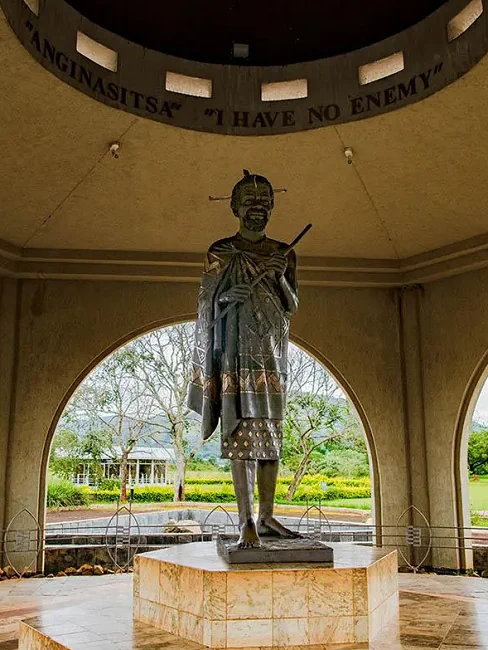
In the heart of South Africa, Lobamba, the traditional capital of Eswatini a small but deeply rooted kingdom with a mountainous and verdant landscape is a city that carries the freedom struggle and royal heritage of a nation. King Sobhuza II, who holds the title of the longest-reigning monarch in recorded history, remained on the throne for 82 years and 254 days; he became the founding architect of Eswatini, which gained its independence from British colonial rule in 1968. Lobamba today is home to a monument statue and park complex that keeps his name and legacy alive. This structure has become an indispensable stop for history enthusiasts and tourists visiting the region.
Construction and History of the Statue
The King Sobhuza II Memorial Park was established immediately after King Sobhuza II's death on 21 August 1982, at the site where his body was laid in state, and was officially opened on 13 May 1994 under the leadership of his son, King Mswati III. The park is managed by the Eswatini National Trust Commission (ENTC) and is located in Lobamba, directly across from parliament, right next to the National Museum and Somhlolo Stadium. Both national and symbolic integrity were observed in the park's construction; every detail such as the hexagonal architectural plan, orientation, and landscaping was carefully associated with Swazi traditions and royal symbols. The park was designed as a comprehensive complex consisting of a memorial statue, mausoleum, museum, and expansive green areas.
Features and Artistic Details of the Statue
The 3-meter bronze statue at the center of the park depicts King Sobhuza II in traditional Swazi royal attire, in a dignified and powerful stance. The orientation of the statue is highly meaningful: the figure is positioned facing east, as according to Swazi tradition, the Swazi people are considered a people who came from the direction of the rising sun, that is, from the east. This direction also points toward the sacred Mdzimba Mountains where Sobhuza II's father's grave is located. The shields surrounding the statue carry a particularly special symbolic meaning: they reflect Sobhuza's central position within the kingdom and his nature as both a member and head of the regimental system. The hexagonal plan of the park also holds various symbolic meanings that align with Swazi cultural values. The park also contains a glass mausoleum where his body was displayed, which is guarded day and night, and a flame is lit in this area during important ceremonies.
The Park and Its Surroundings
King Sobhuza II Memorial Park is located in Lobamba, the traditional and political capital of Eswatini. Lobamba forms the cultural and administrative center of the country with its parliament, National Museum, and Somhlolo Stadium. A small museum is also located within the park, displaying archival photographs and documents from King Sobhuza II's long life and reign. Visitors can take advantage of discounted combined tickets covering both the Memorial Park and the National Museum. Lobamba is only a few kilometers from Eswatini's administrative capital Mbabane and is easily accessible along the Ezulwini Valley. Additional points of interest in the vicinity include Mlilwane Wildlife Sanctuary, Swazi Cultural Village, and Mantenga Nature Reserve.
The Legacy of Sobhuza II
King Sobhuza II was born on 22 July 1899 at the Zombodze Royal Residence. Having lost his father when he was only four months old, Sobhuza was raised under the guardianship of his grandmother and uncle, and officially ascended to the throne in 1921. Throughout his reign, he both personally negotiated with King George V in London and pursued international legal avenues to reclaim Swazi lands from white settlers. Playing a decisive role in the founding of Swaziland (present-day Eswatini), which gained its independence from Britain on 6 September 1968, Sobhuza dissolved the constitution in 1973 and chose to govern the country through the traditional royal system. Sobhuza II, who maintained the longest reign in recorded history, passed away on 21 August 1982 at the age of 83. Regarded almost as a sacred figure by the people of Eswatini today, Sobhuza II continues to be referred to by the title of "father" of modern Eswatini.
Visitor Information
King Sobhuza II Memorial Park is located in Lobamba, Eswatini, across from parliament. The park, approximately 11 kilometers from Eswatini's administrative capital Mbabane, is easily accessible by vehicle. The park is operated by the Eswatini National Trust Commission and has an entrance fee; a combined ticket option with the National Museum is also available. The most suitable period to visit the region is between April and September, when mild weather prevails. When planning a visit, the nearby National Museum, Swazi Cultural Village, and Mlilwane Wildlife Sanctuary can also be added to the itinerary.
Date Added: