Jose Batlle y Ordonez Statue - Uruguay Montevideo
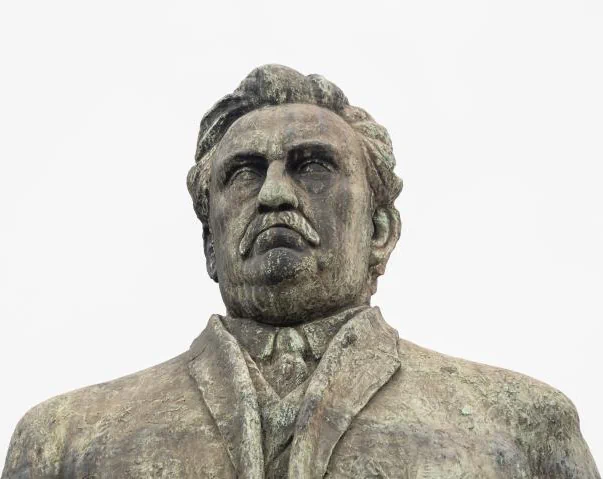
Rising at the intersection of Avenida General Flores and Avenida Daniel Fernández Crespo in the historic fabric of Montevideo, the José Batlle y Ordóñez Statue is more than just a monument; it is an expression of Uruguay's modern identity cast in stone and bronze. Created by Uruguayan sculptor Federico Moller de Berg, this work was inaugurated with a ceremony on May 17, 1980, and has since become one of the city's landmarks. The standing figure, rising on a brick-clad concrete pedestal crafted in bronze, conveys to visitors the resolute stance and reformist spirit of Don Pepe.
Don Pepe: The Man Who Rebuilt Uruguay
José Batlle y Ordóñez was born in Montevideo on May 23, 1856. His father, Lorenzo Batlle, was a former president of Uruguay, meaning politics was practically an inherited legacy for him. He began studying law but never completed it. His true passion was journalism. The El Día newspaper, which he founded in 1886, was not merely a publication but the most powerful vehicle through which he conveyed his ideas and reformist vision to society. That same year he took part in the Quebracho Revolution, boldly stepping onto the political stage and never looking back.
Batlle y Ordóñez served two terms as president under the Colorado Party: 1903–1907 and 1911–1915. During his first term, he was forced to confront the armed conflicts tearing the country apart. He skillfully suppressed the armed uprising led by caudillo Aparicio Saravia using a modern army and the technological capabilities of the era telegraph and railway. This victory effectively brought an end to Uruguay's civil war era inherited from the 19th century. Historians regard this moment as the beginning of the country's transition to a genuine modern state.
The Architect of Reform: The Welfare State and Democracy
What makes Batlle y Ordóñez one of the most distinctive figures in Uruguayan history is not simply that he held power, but how he used it. While the vast majority of Latin American countries at the time were struggling under oligarchic structures, he set out to transform Uruguay into a social welfare state. Drawing on French positivism and Krausist liberalism, he firmly believed that the state had a duty to protect society's most vulnerable.
The reforms enacted during his second presidency still carry a remarkable progressiveness today. The eight-hour workday legislation passed in 1915 was a historic achievement for the working class. The State Insurance Bank was established in 1911; the Republic Bank and the Mortgage Bank were nationalized. Secondary schools were opened, a Women's University was founded, and Faculties of Engineering and Architecture were established. In addition, the death penalty was abolished, the profit margins of foreign companies were restricted, and comprehensive support was provided to immigrants.
Batlle y Ordóñez also took a remarkably progressive stance for his era on women's rights. He supported the divorce law, advocated for the legal protection of children born outside marriage, and laid the groundwork for legislation that paved the way for women's suffrage. Uruguay would become one of the first countries in Latin America to grant women the right to vote; the seeds of this process were largely sown during the Batlle y Ordóñez era.
Batllismo: A Political Legacy That Transcended the Individual
The influence of Batlle y Ordóñez extended far beyond his own presidential terms. The political movement known as "Batllismo" continued to exist within the Colorado Party long after his death and became one of the cornerstones of Uruguay's social democratic identity. His stance on national economics against foreign capital particularly British and American interests and his challenges to large landowners and conservative Catholic circles made him both a beloved and a controversial figure. Yet the verdict of history has largely worked in his favor.
As American historian Russell H. Fitzgibbon put it, in the last two centuries, no individual in any country has left as deep a mark on a nation's life and character as Batlle y Ordóñez did on Uruguay's. This judgment may seem exaggerated; yet when one looks at Uruguay's education, health, and democracy indicators which stand far above the regional average today it becomes clear just how solid the foundation he laid truly was.
The Statue: A Bronze Portrait of a Statesman
Uruguayan sculptor Federico Moller de Berg (1900–1991) depicted Batlle y Ordóñez standing upright, gazing forward. The figure's posture conveys resolve and composure neither a triumphant commander striking a victory pose nor a passive sage seated in contemplation. It is precisely the image of a statesman ready for action, perfectly in keeping with Batlle y Ordóñez's historical portrait. The combination of bronze material and the brick-clad concrete pedestal reinforces a sense of permanence and solidity.
Since its inauguration on May 17, 1980, the statue has been not merely a tourist stop for the people of Montevideo, but one of the points where national memory takes physical form. The surrounding urban fabric continues to pulse with the rhythm of city life, lending the statue the quality of being part of living history rather than a static monument.
Visitor Information
The José Batlle y Ordóñez Statue is located at the intersection of Avenida General Flores and Avenida Daniel Fernández Crespo in Montevideo. It is easily accessible from the city center by public transport, taxi, or on foot. For every visitor wishing to explore Uruguay's capital, this spot stands as a unmissable stop where history and architectural aesthetics converge.
Date Added: