Evita Peron Statue - Argentina - Buenos Aires
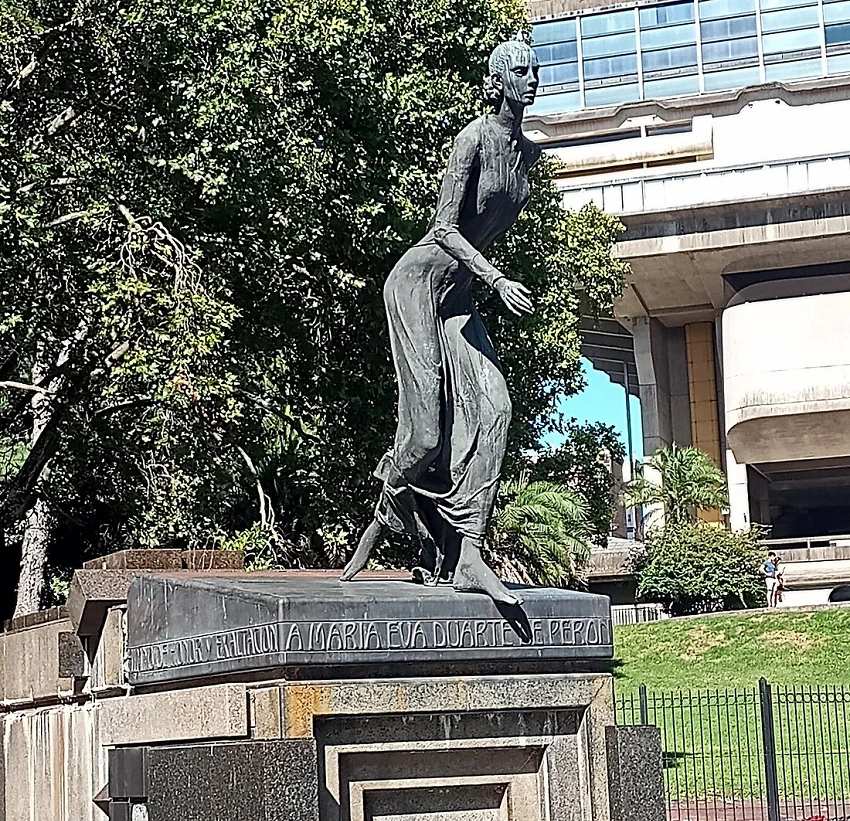
In the Palermo district of Buenos Aires, right next to the National Library, a bronze figure stands tall. This woman striding forward with strength, barefoot, walking toward her people, is the most controversial and most beloved name in Argentine history: María Eva Duarte de Perón. The people know her simply as "Evita." Little Eva. But the mark she left was never small. She lived a short yet profound life. In 33 years she won the hearts of millions and continued to be debated, loved and despised long after her death. The statue in Buenos Aires is the most important monument carrying both the physical and spiritual trace of this woman.
Location and General Features of the Statue
The monument is located in Plaza Evita, between Avenida del Libertador and the streets of Agüero and Austria, within the grounds of the Biblioteca Nacional in the Palermo district. This location is no coincidence; it is the exact spot where Juan and Eva Perón's presidential residence, Palacio Unzué, stood from 1946 to 1955. Eva lived there, fell ill there and died there. After the 1955 military coup the palace was demolished and the land was left empty. Years passed, new structures were built; but eventually Evita's statue was erected on that very same ground. History had come full circle.
Technical Features and Design of the Statue
The monument was designed by Argentine artist Ricardo Gianetti. It consists of a bronze figure set upon a granite base, reaching a total height of approximately 20 meters. The most striking feature of the statue is Evita's posture: head held high, stepping forward, barefoot. Being barefoot is a deliberate and symbolic choice. Through this detail the designer visually expressed Evita's deep bond with the "descamisados" the shirtless ones, the poor, the workers. The ground around the statue is laid out in the shape of a Latin cross. Inscriptions summarizing Evita's legacy are carved into the surrounding stonework: "She elevated the dignity of women, protected children, cared for the elderly; she refused all honors." These words make every visitor pause for a moment, going far beyond granite and bronze.
History of the Statue: A Wait That Lasted Decades
The idea of a grand monument for Evita actually dates back to 1951. While still alive, she personally commissioned an enormous project: a 60-meter worker figure, a 77-meter base, 16 marble statues surrounding it. She had Italian sculptor León Tomassi prepare the models. Her instructions were clear: "It will be the largest in the world." But Eva passed away on July 26, 1952 at the age of 33 and the project was left unfinished. With the 1955 military coup all traces of Peronism were erased. For decades there was no official structure in Buenos Aires to commemorate Evita. A law passed in 1986 made the monument mandatory; a design competition was announced in 1997 and the location was determined. President Carlos Menem inaugurated the still-unfinished monument in a ceremony on December 3, 1999, the last day of his term. A long historical silence had finally come to an end.
Who Was Eva Perón?
María Eva Duarte was born on May 7, 1919 in Los Toldos, a small town in the province of Buenos Aires. Being born out of wedlock carried a deep social stigma in Argentina at that time. She lost her father at the age of six and the family fell into poverty. At fifteen she went to Buenos Aires with only a few coins in her pocket; her goal was clear, she wanted to be an actress. She started in small theater groups and moved on to radio plays. By the 1940s she had become one of the highest-earning radio actresses in the country. The 1944 San Juan earthquake changed her fate; she met Colonel Juan Domingo Perón who was overseeing the disaster relief organization. The two began living together. When Perón was arrested in 1945 Evita ran to the trade unions, organized rallies and mobilized the people. On October 17, 1945 more than 300,000 workers flooded the streets, the government backed down and Perón was released. They married a few weeks later. In 1946 Perón won the presidency and Evita became First Lady.
The Years in Power: The True Voice of the People
Evita held no official government title yet she was one of the most powerful political figures in the country. She personally conducted union negotiations, raised workers' wages and transformed working conditions. Through the Eva Perón Foundation she established thousands of hospitals, schools, orphanages and nursing homes. In 1947 she championed women's right to vote; Argentina took that historic step the same year. Every day she listened to hundreds of poor people who came to visit her, gave them money, found them jobs and provided shelter. The aristocracy looked down on her, the right wing despised her; but the people loved her almost like a saint. There was no middle ground: you either loved Evita or you hated her.
Illness, Death and the Birth of a Legend
From 1950 onward her health began to deteriorate. Her cervical cancer diagnosis was not disclosed to the public for a long time. At the presidential parade in June 1952 she managed to stand upright with a metal and plaster brace hidden beneath a large fur coat, waving to the crowd on a triple dose of painkillers. That scene went down in history as the unique image of both power and the fragility that comes with mortality. She passed away on July 26, 1952 at 20:25 at the age of 33. Argentina declared official mourning; the funeral queue lasted for days and people lost their lives in the crush. No death in this land had ever caused such immense public grief.
Visiting the Statue: Practical Information
The Evita Perón Statue is open and free to visit 365 days a year. Palermo is one of the most vibrant neighborhoods in Buenos Aires with cafes, restaurants and green parks all around. Bus number 130 passes right by the monument. If you are coming by metro the nearest station is Scalabrini Ortiz. The early morning hours are ideal both for photography and for a quiet experience. On the same day you can also visit the Duarte family crypt at Recoleta Cemetery and Museo Evita in Palermo to follow Evita's footsteps one by one.
Date Added: