Catholic Isabella and Christopher Columbus Monument
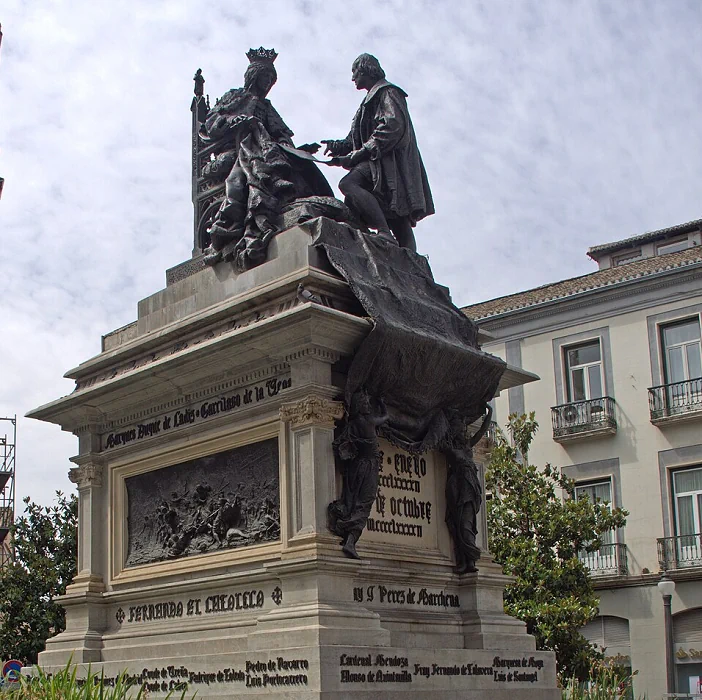
Located in Spain's Andalusia region, Granada has drawn visitors from all corners of the world for centuries with its history-soaked streets and unique heritage. Right in the heart of the city, at the intersection of Gran Vía de Colón and Reyes Católicos, stands a statue unlike any other those bronze figures are not merely a work of art, but witnesses to an entire era. The monument at the square known as Plaza Isabel la Católica brings together Queen Isabella I of Castile and Christopher Columbus at one of history's most critical moments.
The Moment the Statue Depicts: The Capitulations of Santa Fe
The statue portrays a remarkably singular scene: Queen Isabella is seated on a magnificent Gothic-style throne, holding out a document to Christopher Columbus. This document is none other than the Capitulations of Santa Fe the agreement that authorized Columbus to set sail for the Indies. Columbus stands before her, bowing respectfully, as if on the verge of unlocking the doors of an entire era. Unknowingly, he was also about to step toward the discovery of a new continent: America. This scene is a frozen image of that encounter in 1492, a meeting that changed the course of human history forever.
Mariano Benlliure: The Master Behind the Work
The name behind this great monument is Mariano Benlliure, one of the most important Spanish sculptors of his time. Born in Valencia in 1862, Benlliure moved to Rome at a young age and honed his craft to the highest level there. Known for his realistic style, delicate craftsmanship, and ability to work bronze as though it were a living material, the artist was only in his early thirties when he completed this work. One detail many people don't know: Benlliure did not create the statue in Granada itself. The entire monument took shape in the master's studio in Rome, where the casting was carried out at Alessandro Nelbi's foundry. The completed pieces were then transported to Spain.
The History of the Monument
The story of the monument is the product of a rather turbulent process. The year 1892 marked the 400th anniversary of Christopher Columbus's discovery of America, and Spain was eager to commemorate the occasion with great enthusiasm. The Municipality of Granada set out to erect a fitting monument for the city and opened a large-scale competition. However, none of the four sculptors who entered managed to fully satisfy the jury, and the competition was declared void. The Prime Minister of the time, Antonio Cánovas del Castillo, personally stepped in and commissioned the work directly from Benlliure. Following the contract signed in January 1892, the artist worked virtually without pause for nearly eight months to meet the deadline. The pieces arrived in Granada in September 1892, and Benlliure personally oversaw the assembly process.
Its Current Location: Plaza Isabel la Católica
The monument remained at its original location on the Paseo del Salón until the 1960s. Granada's mayor at the time, Manuel Sola Rodríguez-Bolívar, carried out a comprehensive urban renewal project to reorganize the city center. As part of this project, a new square was created at the start of Gran Vía de Colón, and the statue was relocated there. Today, this square known as Plaza Isabel la Católica has become one of Granada's busiest and most recognizable intersections. When the statue was moved, its orientation was also subtly adjusted: Queen Isabella's gaze now turns not toward the Sierra Nevada, but westward toward America.
Materials and Artistic Features of the Statue
The monument was cast in bronze using the "lost wax" (cera perdida) technique. This ancient method preserves the finest details in the casting process, and Benlliure made masterful use of it. The faces of the figures, the folds of their garments, and the positioning of their hands are rendered with almost photographic realism. All these bronze figures rise on an ornate pedestal made from stone quarried in Sierra Elvira. The composition takes on a pyramidal form through the steps surrounding the throne and the rising volumes, naturally drawing the eye toward the queen's crowned head. The reliefs decorating the pedestal depict significant scenes from Spanish history.
A Note for Visitors to Granada
Plaza Isabel la Católica sits right at the heart of the city, making it a square that visitors pass through on almost any route. The C3 bus to the Alhambra Palace also departs from this very square. Beyond the statue itself, the cafes and historic buildings surrounding the square make it a perfect spot for a short break. Seeing the monument in the early morning hours or in golden hour light brings out the bronze's distinctive greenish-blue patina in a far more striking way. To stand in this square in Granada is not simply to see a statue it is to stand at the very moment where the Middle Ages ended and the modern world began.
Date Added: