Arturo Prat Sculpture Monument - Chile - Valparaiso
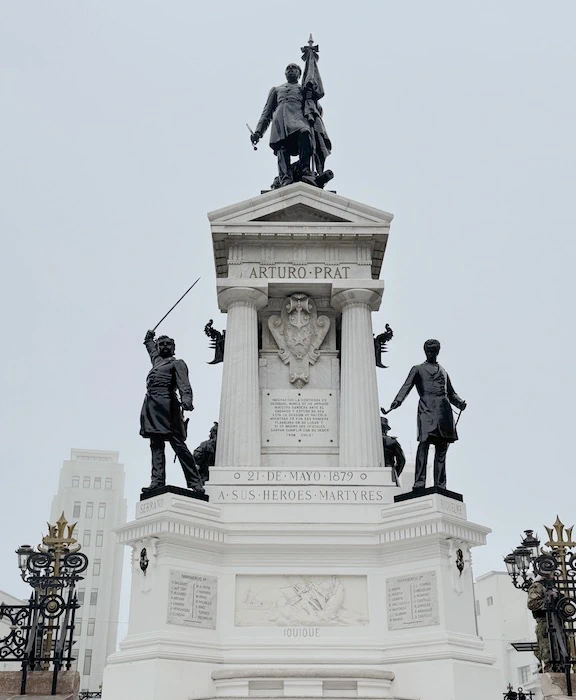
Located in the heart of Valparaíso, Chile's colorful port city, the Arturo Prat Monument in Plaza Sotomayor is not merely a sculpture; it is a work that carries the history, pain, and pride of an entire nation. Situated in this historic square on the UNESCO World Heritage List, the monument was erected in memory of Captain Arturo Prat Chacón, one of Chile's most important national heroes, and the sailors who lost their lives in the Naval Battle of Iquique. With its white marble pedestal, bronze figures, and the Prat statue at its summit, this structure continues to stand as one of the most striking examples of Chilean sculptural art and national memory.
Who Was Arturo Prat?
Arturo Agustín Prat Chacón was born on April 3, 1848, in Ninhue, Chile. Admitted to the Naval Academy in Valparaíso at the age of eight, Prat graduated as an officer in 1864. He quickly distinguished himself through his meticulous work discipline, deep sense of responsibility, and unwavering devotion to his country. He was also an intellectual who had studied law and carried out various academic works. When the War of the Pacific broke out in 1879, he was assigned by Admiral Juan Williams Rebolledo to command the wooden corvette Esmeralda. Until that point, he had only ever been given old and worn-out vessels, yet Prat never once used those circumstances as an excuse.
The Naval Battle of Iquique: May 21, 1879
On the morning of May 21, 1879, the Esmeralda and the Covadonga, which were maintaining a blockade of the port of Iquique, were surrounded by Peru's modern and powerful ironclads, the Huáscar and the Independencia. The imbalance of forces was strikingly clear from the very beginning. The Huáscar repeatedly rammed the Esmeralda and subjected her to heavy artillery fire. Despite this, the thought of surrender never entered Prat's mind. Rallying his crew, he launched a boarding attempt on the Huáscar with the cry of Viva Chile. During this daring move, he was struck by fire from Peruvian sharpshooters and lost his life. He was only thirty-one years old. This heroic death was received by the Chilean people with profound shock and deep reverence. Even the enemy commander Miguel Grau was moved by Prat's courage and personally delivered his condolences and Prat's belongings to the family.
The History and Architecture of the Monument
Just seven years after the battle, the monument was ceremonially unveiled on May 21, 1886, in Plaza Sotomayor, brought to life through public donations and government contributions. The work of French sculptor Denys Pierre Puech, the monument was built under the supervision of architect Norbert Maillart, while the craftsmanship of the pedestal was carried out by Chilean stonemasons. At the top of the monument stands the figure of Prat with a sword and flag, while at the four corners of the pedestal, bronze sculptures depicting the other heroes of the battle rise proudly. Inscribed on the pedestal are the words "21 de Mayo 1879" and "A Sus Heroes Martires," phrases read in silence each year by thousands of visitors. In the crypt beneath the monument, the remains of Arturo Prat and his fellow sailors are preserved.
Plaza Sotomayor: The Historical Significance of the Square
Plaza Sotomayor, where the monument stands, is the most important focal point of Valparaíso's civil and maritime history. The square takes its name from Rafael Sotomayor, a prominent statesman of the 19th century. Surrounded by the Chilean Navy Command building, historic commercial structures, and port facilities, the square was declared a Typical Chilean Zone on January 23, 1979, and placed under protection. During a comprehensive renovation carried out in 2000, archaeological excavations conducted beneath the square brought historic port remains to light. Today the square continues to serve both as a bustling public space that pulses with the rhythm of daily life and as a living museum of Chilean maritime history.
Annual Commemoration Ceremonies
In Chile, May 21 is Navy Day, an officially recognized national holiday. On this special day, Plaza Sotomayor becomes the center of the commemoration. Wreath-laying ceremonies and military parades are held with the participation of naval officers, students, and the general public. The President and other senior government officials also attend the ceremonies to keep alive the memory of Prat and the martyrs who fought alongside him. This annual ritual serves as a reminder, time and again, that the monument is not merely stone and bronze but the embodiment of a living national memory.
Beyond a Work of Sculpture
The Arturo Prat Monument must be regarded not only as a purely aesthetic work but also as a vehicle that transmits a society's values, its understanding of heroism, and its historical identity from generation to generation. Viewed from the perspective of sculpture art, the monument stands out for its masterful composition reflecting the French academic style of its era, the intricate craftsmanship of its bronze figures, and the architectural balance of its white marble pedestal. Monument sculptures are the most enduring expressions of a nation's relationship with its own history. Every foreign visitor who stands in this square in Valparaíso comes to know not merely a city, but the soul of a country.
Date Added: